
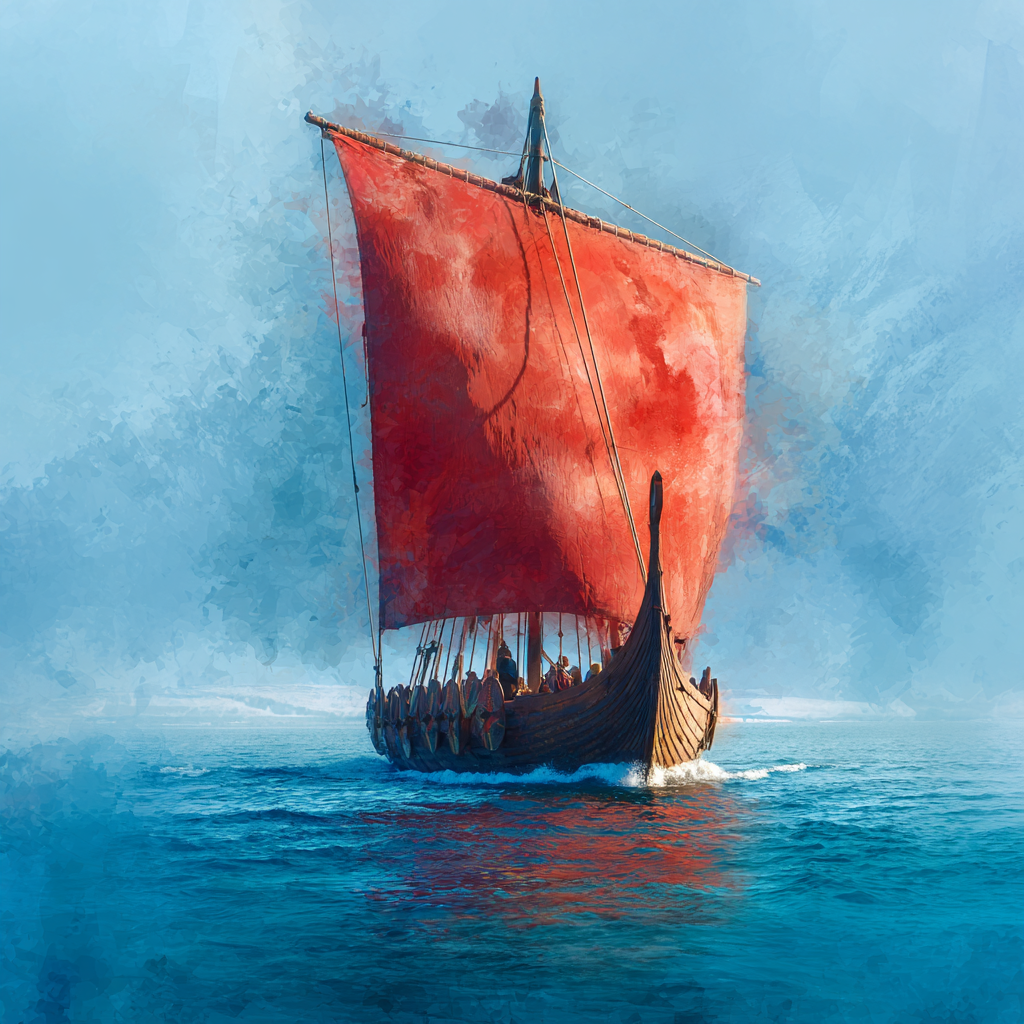
Norway. Why would I want to go there? Simple: book research—a long time coming. To walk, drive and sail through lands steeped in myth and memory. To see with my own eyes the fjords, the forests, the wild oceans and the preserved remnants of Norse culture that have haunted my imagination for years.
At first, I thought I’d go it alone. But back in the spring, when I had barely started sketching the outlines of the trip, I asked my sister Melissa if she’d like to come. She didn’t miss a beat. ‘Yes.’ No hesitation. My sister is an adventurer at heart—every bit as much as I am.
I booked our flights from the comfort of my Quebec mountainside cabin as the temperatures warmed, and just like that, my brain kicked into high gear. Ideas. Plans. What we’d see. What we’d feel. What we might discover.
I took the cozy train from Ottawa to Toronto to meet Melissa at the airport. We were set to fly across the Atlantic together at 5:30 p.m., bound for Copenhagen. From there, we’d jump over to Oslo. While waiting at the Copenhagen airport, we killed time with one of our favorite travel activities: people-watching. Airports are goldmines for that—endless seas of humanity, every face its own story.
We landed in Oslo at 9:30 a.m. No sleep on the plane, but it didn’t matter. Adrenaline was pumping. I always get a hit of that when I land somewhere new. A clean slate. A blank map. An open adventure!
We checked in at the car rental counter and got a free upgrade—gas to electric. The agent reassured us that Norway is one of the most electric-car-friendly countries on the planet. Our ride: a sleek Volkswagen compact SUV. Smooth, quiet, effortless.
With GPS set, we made our way to our hostel—hostels being our go-to for this trip in hopes of keeping things financially reasonable (read: not bankrupting ourselves). We dropped our bags, I grabbed a lightning-fast shower, and then we were out the door. We didn’t even glance at the beds. Sleep could wait.
We parked downtown and started walking. Oslo’s streets had an understated elegance to them—sharp suits, sleek coats, polished boots. It was a Monday morning, and we figured the well-dressed folks around us were bankers, politicians and professionals floating between cafés and meetings.
Our first stop: The Viking Planet Museum. The original Viking Ship Museum is closed until 2026, so this immersive tech-driven spot was our consolation prize—and honestly, it delivered. VR exhibits, epic lore and even a virtual tour of the closed museum. There was one segment where wore a VR headset and through it we sat on the deck of a Viking ship while flaming arrows screamed overhead. In another VR game we fired back with a virtual bow at raiders onshore, and when one of them leapt onto the longship—you could either fight him off or cut him down with a sword. Not bad for a stand-in.
Next stop: The National Museum, which turned out to be a total gem. So many exhibits, from classic to contemporary. Culture rich, we soaked it in until hunger kicked in.
For dinner, I ordered reindeer. Melissa—ever the comedian—grinned and asked our waiter if I was eating Rudolf. Without skipping a beat, and a gigantic smile on his face, he gave us a history lesson on the reindeer of Norway. Melissa went with fish. The reindeer was excellent. Rich, tender, and cooked just right.
On the drive back, the lane-correction system in the car kicked in a few times to save me from drifting. After 36 hours without sleep and a full belly (not of Rudolf but maybe of Dasher), I probably needed a fully self-driving vehicle. The world is not quite there yet… but soon?
We collapsed into our pillows and were out cold.
Day One: complete. Norway was already working its magic.

After a solid sleep and a quick pit stop at the hostel buffet, we hit the road in our electric Volkswagen. I was curious—how easy would it actually be to keep the EV charged across Norway’s winding countryside?
Turns out: mostly easy… with a few white-knuckle moments.
We did run into some growing pains. A few tight situations where the battery dipped low, and we found ourselves out in the middle of nowhere wondering if the Norse gods still took sacrifices. In metaphor only of course. I’ll give up alcohol. Wait. It can be a sacrifice if you’ve already done it. But overall, we got the hang of it quickly. Charging stations were plentiful and user-friendly. The only real catch? Waiting. You’ve got to factor in time to let the car juice up. It’s perfect for a pee break and a snack. If you’re lucky, you land at one of those beast-mode stations that’ll get you back on the road in 40 minutes, fully topped up with 400 km of range.
Our plan was to drive along the southern coast with a few key stops before heading north to Stavanger by nightfall. First stop: Borre.
At Borre, we wandered among ancient Norse burial mounds—massive, grass-covered hills tucked into a quiet, forested stretch of land that ended at the sea. The site is part of the Midgard Viking Centre, and it felt like stepping into another century. The village recreation was solid, especially the towering feast hall that dominated the landscape. Unfortunately, a school field trip kept us from going inside—but even from the outside, it was an impressive build. Thick timber walls, long tapered roof—exactly what I pictured in my mind while writing my book.
Inside the Centre, we browsed a collection of relics: bent swords, rusted tools, ancient jewelry. Old metal and bone humming with story. I picked up a souvenir T-shirt—first of many. We took a quiet stroll around a nearby church. Fascinating to see the spiritual shift—how Norse culture moved from the old gods to the new one.
From Borre, we made our way to Tønsberg.
There, we stumbled into an incredible museum showcasing Viking relics, including pieces of an actual longship. I was stoked to get up close with the craftsmanship—the way Norse builders stitched wood and iron together to forge vessels that could cross even the most rageful oceans. One exhibit, surprisingly moving, featured a full-scale whale skeleton display. Melissa and I wandered among the full skeleton of a blue whale, an orca and a sperm whale—massive and humbling.
We eventually made our way to the harbour. This part of the trip? It hit me hard.
First, we came across a fully functional longship docked peacefully on the water. Just sitting there like it belonged—because it did. It’s incredible to think how far the Norse traveled in these vessels. Through wind, rain, and monstrous waves. In my research, I’d learned how brutal the journey from Iceland to Greenland was. Many never made it. The sea took its tithe.
But then it happened. A moment that felt like fiction bleeding into fact.
As we walked the docks, we heard the smooth grinding of lathes one wood and the tap of hammers on nails. Drawn in, we came upon a small shipyard where two older men and a young man were building a longship by hand. The young man, cut away at planks. One man bald, bearded, and instructing. And then I froze.
If you plan to read my novel The Last Northmen, consider this your spoiler alert.
In my book, one of the main characters—Regark—is a young man apprenticing under a bald shipbuilder named Tennat. Together, they build a Viking Knörr. Standing there, I saw Regark. I saw Tennat. In the real world. It felt like I’d accidentally stepped from our current reality and into my own manuscript.
I didn’t film. I didn’t ask questions. I just watched—quietly—knowing that memory was burned into my brain for good.
After that surreal encounter, we grabbed a delicious fish lunch, loaded up and hit the road again. The EV hummed along smoothly as we cruised across coastal roads, weaving up and down through steep fjords under a darkening sky.
Pro tip: Norwegian roads are loaded with speed cameras. Drive like someone’s watching—because they are.
We rolled into Stavanger at midnight. Dead tired. We had underestimated how long each leg of the trip would actually take, but that’s part of the fun. Going forward, we’d adjust—and always keep a full stack of energy drinks in the backseat.
Day Two: complete. Adventures in motion!

We weren’t slowing down. We had ten days to explore this fabled land, and we were grinding to make the most of every single one. Day three was no exception.
We left our hostel early and made our way toward the coast. Not long after, we were standing beneath three massive bronze swords rising from the stone by the sea at Hafrsfjord, just outside Stavanger. This place is called Sverd i fjell—Swords in Rock.
It was surreal standing there. The swords aren’t made of stone, but the way they pierce the rocky outcrop makes them look like they’ve stood there since the time of legends. This monument commemorates the Battle of Hafrsfjord in 872, where King Harald Fairhair unified Norway into one kingdom. Each sword represents a king—Harald’s being the largest. Sculpted by Fritz Røed and unveiled in 1983, they were embedded in the rock to symbolize a peace that would never be broken again. Never drawn. Never used in war.
After taking it in, we jumped on the highway and drove north toward Preikestolen—Pulpit Rock.
Norway has a lot of tunnels. And I mean a lot. One of them took us deep under the ocean. As we drove through this submerged marvel, it hit me: there were likely thousands of tonnes of seawater pressing down above our heads. It was intense. And awe-inspiring. The engineering in Norway is absolutely next level—long tunnels, winding roads, cliff-hugging bridges—it’s all part of the journey.
Our mission: to hike to the top of Preikestolen and get that iconic shot, standing where the rock meets the sky.
Preikestolen is one of the most famous landmarks in Norway—and when we got there, the crowd made that clear. The hike itself took about two hours, and when we reached the summit, the wind was howling—roaring across the plateau with wild abandon. I genuinely worried some of the lighter folks might get launched right off the cliff and into the fjord below. But the view? Unreal. A vast stretch of glacial-carved beauty, deep water, stone walls, endless sky. Worth every step of the climb.
I’m quite proud of my sister and I—we pushed through, reached the top, and stood together high atop the Norse world.
After soaking it in (and snapping a few photos to prove it), we descended the rocky trail and began our next journey—this time heading inland, toward the heart of Norway. But first, pizza.
We drove east toward Gudvangen, full stomachs and full hearts. Along the way, we reflected on how totally off our time estimates had been. Norwegian roads wind, dip and curve with the land, and the speed limit on these windy roads rarely breaks 80 km/h. To be on the safe side I drove at 60 km/h. That means slow going—but it also means the journey itself becomes the experience.
We crossed bridges, climbed mountains, dipped through tunnels and even rolled our car onto a ferry to cross a fjord.
Eventually, beneath the quiet gaze of towering mountains, we arrived at our camping cabin under a blanket of stars. The mountains loomed like silent watchers in the night. We hit our pillows at 1:00 a.m.
Day Three: complete. Tomorrow? Another early start. And we were ready.

I stepped out of the cabin around 7:00 a.m. The sky was already bright and ablaze with daylight, but what hit me more than the light was the sheer presence of the two massive mountains that flanked us. I hadn’t seen them properly the night before when we rolled in under the cover of dark—but now, in the fresh morning air, they towered like ancient sentinels. A proper awesome moment.
We packed up and hit the road—first stop: a Viking village.
We pulled in just in time to catch one of the the morning tours. Our guide? Straight out of a saga. He was a Viking. He walked like one, talked like one, and brought the entire experience to life with equal parts humour and deep knowledge. We were hooked from the first step.
At one point, we were examining Viking weapons when he motioned for me to grab a shield and sword. Then he grabbed a Dane axe, the very weapon wielded by Thorensten the Far, my main character in The Last Northmen and The Northman’s Thrall (release date January 2026). I felt a surge of excitement (and, not gonna lie, a little envy).
He raised the axe, I braced behind my shield—and for a split second I thought I might actually lose my head. Then he smiled and said, ‘Let me show you’. He demonstrated how Vikings would hook the opponent’s shield arm with the axe after a strike, then plunge the blade straight into the body. It was a terrifyingly efficient move—and a great addition to the mental arsenal for my next novel. Later when I sought to pose with the Dane axe I asked another Viking villager (the people that ran the place had literally chosen to live their full lives in 2025 and beyond as Vikings) if I could grab the Dane axe for a photo. He proceeded to make a joke about the Danes ‘they needed such a big weapon to compensate for small penises’. It took me a moment, but I got it. Testament to lingering animosity towards the Danish conquerors of Norway in Medieval times.
From there, we moved into the world of Norse daily life—textiles, trade routes, blacksmithing and tools of the past. We learned how they made vibrant, colourful clothing using materials from animals, trees and plants gathered from across the known world. It was awe-inspiring stuff.
Our guide eventually directed us to the Jarl’s longhouse, which he didn’t tour personally, but insisted we check out. Before that, though, I had one more challenge: a sword fight.
The young man, a swordsman of the village, and I faced off using metal swords wrapped in heavy-duty plastic—still intimidating and not easy to swing. I squared off against a him, as he was quick on his feet, calm and collected. He made short work of me. Reviewing the footage later, I definitely looked like a stiff old man doing his best impression of a Viking warrior. But it was fun. What I needed was a Dane axe and brute strength.
After that, Melissa and I threw spears at targets, hurled axes at shield boards and most thrilling of all—fired real bows and arrows at painted boar targets. Totally immersive. My inner Viking was singing.
Then we entered the longhouse.
It was dark inside. Candles flickered on tables and walls. It was quiet, almost sacred—until we noticed something… or someone. Seated at in the hall, on a throne in the shadows, was the Jarl himself—an old man with a long grey beard and eyes that looked like they’d seen the rise and fall of kingdoms. He welcomed us in with a slow nod.
Inside, we found a table where we could use blocks to spell our names in Viking runes. And best of all—there it was: a game of Hnefatafl, set up and waiting.
I turned to Melissa and asked if she wanted to play. She’s always up for a challenge. I explained the rules—how the king starts in the middle, surrounded by defenders, while attackers close in from the edges. The goal? Get the king to safety. It’s Viking chess—and yes, it’s featured in both of my novels. She played well, but I managed to squeak out a win. Playing Hnefatafl in the Jarl’s longhouse? That one’s going in the memory vault.
We grabbed a few more T-shirts (souvenirs are basically my travel tax), and then we hit the road again—destination: Bergen, to the northwest.
As usual, we stopped in little towns along the way. Some were packed with rich history, especially the churches. Melissa wanted to see as many of them as possible. One highlight was a stave church, perfectly preserved. It was near Bergen. There we found a stone cross smashed into the rock—a clear, ancient message: Pagan Norse gods were to be forgotten. Christianity was here to stay.
Bergen was stunning. The colours of the wharf, the scent of salt in the air, the buzz of coastal life. We walked the docks and settled in for dinner. I had the fish soup, and it was absolute magic. Warm, rich and full of flavour.
Just when we thought we were winding down, I had an idea:
‘Let’s relive our youth,’ I said. ‘Let’s find that bar in the old bunker I found while researching Bergen.’
We found it—a literal bar built into an old wartime bunker. Very metal. When we stepped inside, we were hit with that familiar feeling of being the oldest people in the room by at least three decades. Teenagers and twenty-somethings were living their best lives. We chuckled, pushed through the awkwardness, and explored.
It was actually a pretty cool place. Quiet at first—though to be fair, it was only 9:30 p.m. We grabbed a drink and sank into a pair of ripped-up couches, laughing about the full-circle moment. Then we noticed the mural on the wall—two horses fucking. Yep. That was a first. Norway doesn’t pull punches with its décor.
Eventually, the fatigue caught up to us, and we made our way back to the hostel.
Day Four: complete. Tomorrow would be another day of adventure. Let’s go!

The next morning, we strolled the Bergen harbour again, weaving through the fish markets, admiring the old architecture and wondering about the stories behind those buildings leaning into the docks. After a slow wander, we boarded a fjord cruise—a long, winding ride deep into Norway’s iconic cliffs.
The boat was big, but we could go up on the roof deck and take it all in—towering cliffs on either side, mist clinging to stone, waterfalls slipping down into deep blue water. It felt magical. Three hours vanished like nothing. Absolutely worth it.
After the cruise, I managed to convince Melissa to check out the Troll Museum—and what a wild ride that turned out to be. The place was packed with virtual reality, augmented reality and even pen-and-paper storytelling. We learned about Norse creation myths, the cultural obsession with trolls and other legendary creatures the Norse believed were part of real, everyday life.
Honestly, when you’re driving Norway’s highways and look into the rocky cliff faces of the mountains, it’s not hard to see them—the trolls in the stone.
That night, we went high-end for dinner, and it was a good call. I had wild salmon, and Melissa had the farmed kind. Strangely, hers tasted more flavourful, while mine was more neutral but—you know—more rugged and ‘natural,’ I guess.
There was only one other couple in the restaurant, and the waitress sat us beside them. Turned out the guy was kind of a legend. He went by Oyster Dundee and apparently owns a major island restaurant off the coast. It was a short but fun conversation. They seemed to be on a date, so we didn’t intrude too much—but if we’d known about his place ahead of time, we would’ve made the trip out to dine there. Maybe next time.
After dinner, we wandered the wharf, heading all the way down to the edge before climbing up into a medieval fortress tower. It had some solid exhibits—bits of history about the Dutch, the English, and Norway’s role during their conflicts. Standing up there, overlooking the harbour, you could really feel the centuries stacked beneath your feet.
That marked the end of our day. We were tired—but we weren’t slowing down. We drove back to our hostel on the outskirts of Bergen and crashed hard.
Day Five: Complete. Tomorrow would be another full one. No rest for the curious.

6:00 a.m. start. Achievement unlocked.
We hit the road early in search of a waterfall to the east—and we found it. Epic. No other way to say it. I could try to describe it, but words fall short. All I know is this: we were standing way up high on a bridge, staring down into a massive valley while water thundered below us. The power, the scale—it shook something loose inside me. One of those burn-it-into-your-memory kind of views.
Back when we were planning this trip in the summer, the idea was to stay overnight at a hotel near the falls. But once we were standing there, we got a little squirrely. We still had a nine-hour drive to Trondheim ahead of us the next day, and I’ll be honest—I was trying to rally myself to take it on, especially since I’d be doing most of the driving. But after some back-and-forth, we agreed: skip the hotel, hit the road and start making our way north.
We ate the hotel fee, sure—but small price to pay for getting ahead and shaving down tomorrow’s haul.
The drive? Scenic as hell.
We passed through tunnels so deep they had roundabouts inside them—actual roundabouts, underground, beneath mountains. Who does that? Norway, apparently. Wild.
We saw the oldest stave church in Norway, tucked in like a relic from a long-forgotten saga. We got a nice tour of the church and learned of its history is rooted in King Trygvasson. Lore goes that he entered this valley and when he learned the inhabitants were still worshipping the Norse gods he threaten to go a-Viking (which basically means raiding and pillaging) in the town if they did not bend to Christianity. It was in many ways a forced conversion for many. I remember years ago when I was a teenager I watched an interview on MTV in which a Scandinavian death metal band spoke about this very thing-forced conversion.
Back on the road, just when we thought the views couldn’t get any better, we climbed high into the mountains and ended up driving alongside a glacier. It was off in the distance but still majestically large. Unreal.
Eventually, we decided to stop in a quiet town called Lom. We’d logged a serious driving shift, and from there, the next day’s drive to Trondheim would only be about three and a half hours tops. Easy.
Losing that hotel fee down south? Totally worth it. We were northbound, ahead of schedule and full of stories.
And that glacier? Still hasn’t left my head.
Day Six: Complete. Northbound!

We rolled into Trondheim late that morning. Cozy little city—easygoing vibes, lots of character. We did a bit of shopping, and I finally scored the hat I’d been hunting for all trip. Mission complete.
In the city center, we came across a towering monument to King Trygvassen—the guy who put Trondheim on the map back in the Viking days. He was King of Norway from 995 to 1000. We wandered the docks for a while, staring out across the water to a nearby island, just soaking in the atmosphere.
To close out the day, we hit the road one last time—about a 40-minute drive to the airport outside the city. Our next flight was waiting. So were the beautiful northern lights. We were gifted a view of them while high in the dark sky.
We found our rental car at the airport the night before, keys tucked under the front mat. A squeaky little Kia, diesel-powered, with over 200,000 kilometres on it. A far cry from the sleek Volkswagen we’d been cruising in, but honestly—who cares? As long as it got us around the islands, we were good. We found our hostel tucked away on the dark coastline.
Day 7: Complete. Next up: explore the Lofoten Islands. Arctic Circle. Northern skies. The real wild north.

That morning, we headed south, taking forks in the road, checking out whatever caught our eye. We didn’t go too far, though—we had an 11 a.m. surf session booked with Unstad Arctic Surf.
Our guide, Andreas, got us geared up—wetsuits, booties, the whole package. Then he told us to grab the fat-tire bikes parked around the back and ride to the beach. He’d meet us there in his van with the boards.
So off we went—Melissa, myself, and our new friend named Sam from the UK. The three of us would be under Andreas’ watchful eye in the water.
I’ve always believed that if you’re surfing a new spot—especially one way up in the Arctic—it’s smart to go with someone who knows the water. Knows the rips, the rocks and the hidden dangers. Someone who won’t let you die while trying to have fun.
Melissa, in perfect form, asked Andreas if we’d get a refund if we were bitten by an Orca. He smiled and said, ‘That’s what insurance is for.’ Then added, reassuringly, that orcas have never been known to attack a human in the wild. Captivity, sure. That’s different. It’s a damn shame what has been done to some of these majestic and free roaming beasts. But free and loose? Never. Apparently, they’re too intelligent for that kind of thing. They can tell the difference between a wet suited human and a seal. Sharks? Not so much.
He also told us about basking sharks—huge creatures, harmless, no teeth. Fair enough. Noted.
When we got to the beach, I was relieved to see it had a sandy bottom, not reef. Reef breaks are predictable, sure—but one bad wipeout and you’re shredded. Sand is softer. A little more forgiving.
Andreas showed us where the rip current ran—off to the left—and gave us the lowdown: when paddling out, stay on the outside of the break, away from the other surfers. ‘Like not going the wrong way down a one-way street,’ I said. He liked that analogy.
He suggested we stay in the whitewater near shore, where he’d help us catch some smaller waves. But once I was on my board and paddling, it all came rushing back. Memories of Bali, of surfing with The Doc and The Saffa. It really is like riding a bike. So, I just went for it—out past the break while Melissa and Sam stayed close with Andreas.
The waves were a bit fickle at first, but they eventually picked up. We all caught waves that day. Every one of us. It felt amazing. I didn’t even bother putting my hood up. I liked the cold on my face. Just the wetsuit, bare head, crashing into the Arctic waters and coming up refreshed every time.
Our hands were frozen at first, but you adapt. We stayed out there for almost three hours.
Eventually, a surf school showed up—thirty Norwegian teenagers, part of a year-long exchange program. Andreas explained that in Norway, kids can spend their gap year doing something like this—surf camp, nature programs, or military service. If you’re super fit, you’re often drafted into the army. Wild.
Later that day, we still had time to kill, so we made good use of it. We drove to the southern tip of the local chain of the Lofoten islands, and what we saw there was nothing short of jaw-dropping.
Towering mountain spires rose straight out of the ocean like the broken teeth of some ancient god. The rock formations glistened—dark, metallic, almost otherworldly. I wrote a poem about them.
mountains
like wet black adamantine armour
the armour of Jötunn
giants waiting to explode forth and rage across the land
Day 8: complete. Energized by the sea.

On our last day of the adventure, we slowed things down—finally. But not before driving farther north to explore a few more coastal villages, admire the sea, the rocks, the mountains, and take in whatever traces of local life we could find.
Eventually, we turned the car around and headed back toward the airport. The rental was starting to act up—the brakes were grinding and squealing with every stop. It didn’t feel right, so I made the call and parked it for good.
We spent the rest of the afternoon posted up at a cozy little café, sipping excellent coffee while I chipped away at the three projects I’ve got on the go in life. Melissa did her thing—relaxed, wandered a bit. It was a quiet, slow-paced ending, and honestly, I needed it. I was beat.
Melissa, on the other hand? Still had energy to burn. She was ready to rock and roll. The car definitely wasn’t.
That evening, we flew back to Trondheim and checked into the hotel attached to the airport. I’d booked it with two things in mind: comfort—and the ability to roll out of bed and walk straight to our gate in the morning.
It was the final stretch. A little luxury before the long sojourn home.
Day Nine: complete.

The trip back wasn’t too bad—though things got tense in Copenhagen. We had about an hour to make our connection to Toronto after landing, and that’s when we saw it: an kilometre-meter-long zig zagging wall of humans packed into the customs and passport control lineup.
No idea why we had to clear customs there—must be an EU thing—but either way, it was not looking good.
We started wheeling and dealing, talking to anyone who looked official. Got some bad directions. Got told to go stand in line. Finally, I caught wind that they were preparing to call the Toronto flight, because boarding was imminent.
We were stuck in the non-EU passport line—a long, slow-moving beast. I was pretty sure we were going to miss the flight. And then, like a miracle, one airport worker yelled, ‘Flight to Toronto?’ A bunch of us threw our hands up.
No hesitation. Melissa and I bee-lined it out of the queue, ducked the ropes and walked straight to the front. I was head down and charging forward while my polite and truly Canadian sister was asking if we could pass. I almost grabbed her by the wrist. We had two minutes left! The customs agent looked less than thrilled, but hey—sometimes you’ve got to push your way through. Missing that flight wasn’t an option.
We made it through passport control, bolted to the gate and got on the flight.
Landing in Toronto felt like surfacing from a dream—tired but somehow energized. Melissa and I said our goodbyes and I hopped a train back home.
And now here I am—back at my cottage, tucked deep in the Quebec mountains, the leaves starting to turn every shade of fire and gold. I’m sitting here, staring out from my deck, reflecting on it all as the sunshine warms my toes. We didn’t have much of it in Norway. But when we did, it was interestingly well timed.
What a journey. Honestly, it almost doesn’t feel like it happened.
Almost like some kind of dream.
Thank for Reading Always!
-Kevin and Melissa